
Investors do not need a perfect company. They need a company that can explain itself clearly under pressure.
A disorganised Series A data room — mismatched KPI definitions, missing IP assignments, folders with no logical structure — forces investment partners to spend their attention on risk management instead of conviction building. That is the opposite of what you want during a fundraising round.
This guide shows you how to structure a data room that investors can navigate quickly, that reduces follow-up questions, and that signals the operational maturity investors are partly assessing alongside the business itself.
Design principles investors notice
A well-structured data room makes two things easy: verifying your claims and identifying what is missing. Both matter.
Security also matters. The IBM Cost of a Data Breach Report 2025 puts the global average breach cost at $4.4M. A fundraising process involves multiple firms, each with different access needs and security postures. Access controls and audit trails in the data room are not just good hygiene — they protect you if the process does not close.
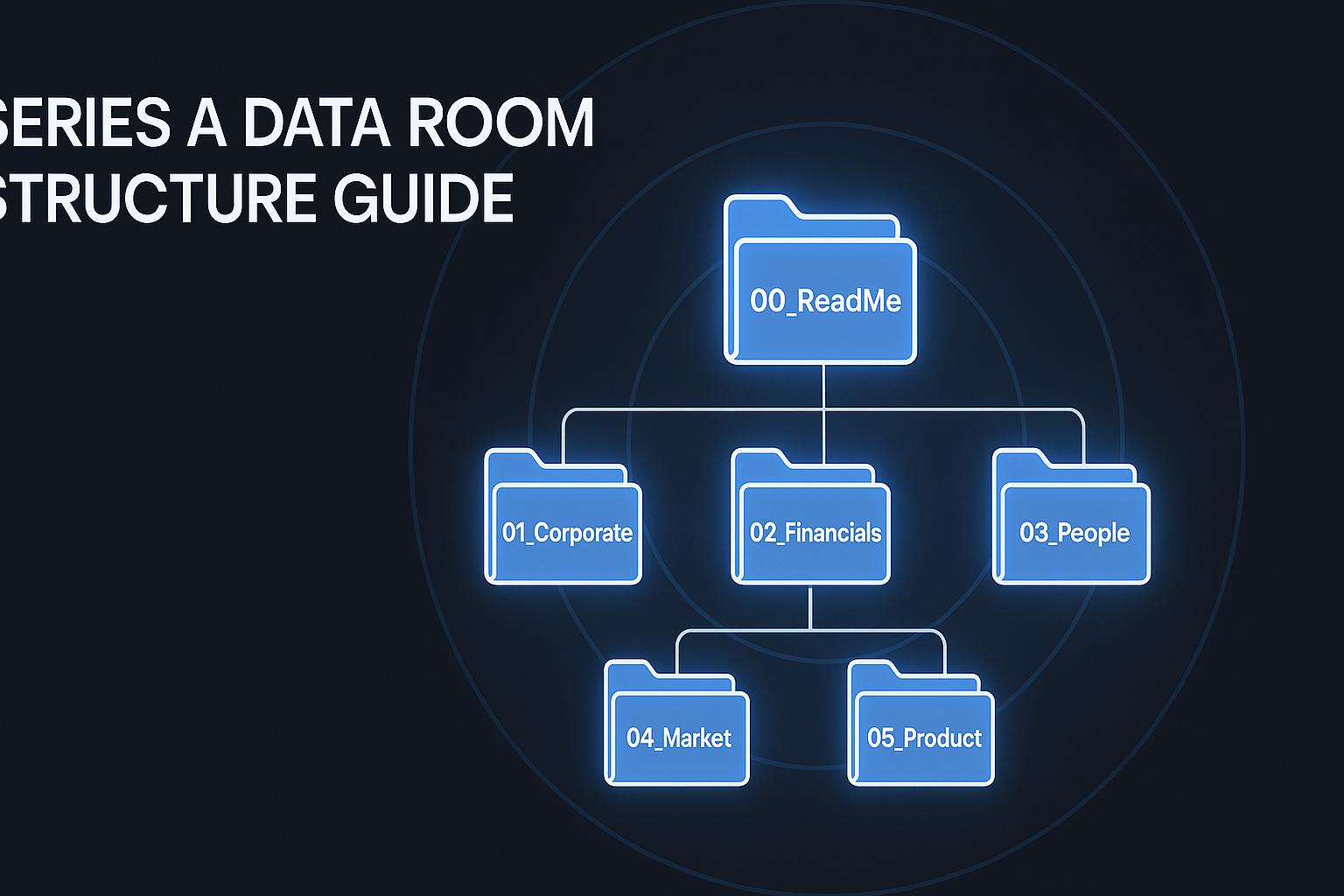
Series A data room: recommended folder structure
Use a numbered system so investors can scan coverage at a glance. Structure mirrors a standard diligence index, which means it is also ready for M&A use if the company is acquired later.
00_ReadMe
- Investor overview: what is included, KPI definitions, contact details, Q&A rules
- Data room changelog (updated each time new documents are added)
01_Corporate
- Certificate of incorporation, bylaws, and all amendments
- Cap table, options pool, SAFEs, convertibles, and board consents
02_Financials
- Historical financials (P&L, balance sheet, cash flow — monthly)
- Burn rate, runway calculation, and bank statements
- Budget vs actuals and financial forecast with assumptions note
03_KPIs and Metrics
- ARR/MRR bridge, cohort analysis, NRR/GRR summary
- CAC/LTV analysis
- KPI definitions page (one page — do not skip this)
04_Customers and Revenue
- Top customer contracts, MSAs, SOWs, and material amendments
- Pricing policy, discount approval framework
- Churn and retention analysis
05_Product and Technology
- Architecture overview and key technical dependencies
- Product roadmap (current and next 12 months)
- Security practices summary: access controls, incident response overview, compliance posture
06_IP and Legal
- IP assignment agreements (founders, key employees, contractors)
- Trademark and patent registrations (if applicable)
- Material disputes or claims
07_Team and HR
- Organisation chart and current headcount
- Key hire plan for use of proceeds
- Employment and contractor templates, equity plan documents and grant summaries
08_Compliance
- Privacy policy and data protection posture (GDPR, CCPA as applicable)
- Vendor list, material subprocessors
- Key policies (information security, acceptable use)
Staged access: what to show first vs later
Showing everything to every investor immediately creates unnecessary risk — and it removes staging as a negotiating tool.
| Stage | Who | What |
|---|---|---|
| Stage 1 — early exploration | All inbound firms | Pitch deck, KPI summary, financial snapshot, basic corporate |
| Stage 2 — active diligence | Firms showing serious interest | Full model, cohort detail, customer evidence, security overview |
| Stage 3 — near term sheet | Lead firm only | Top contracts, deeper IP documentation, insurance, sensitive policies |
Stage access in your VDR so the transition between stages requires only a permission change, not a rebuild.
Naming conventions that prevent the “which version?” question
Investors asking “is this the latest version?” is a friction event that erodes confidence. Prevent it with a naming convention that makes the answer obvious:
[YYYY-MM-DD] [DocType] [Subject] [Status]
Examples:
- 2026-04-01 Financials ARR Bridge Approved
- 2026-05-15 Contract CustomerABC MSA Approved
- 2026-06-01 KPIs Cohort Analysis Investor Copy
Use “Investor Copy” for any document where you have redacted fields. Update the date when the document changes — not by creating “v2” variants.
VDR vs Drive: which tooling to use for Series A
A well-managed Google Drive or SharePoint can work for a single-firm process where you control who has access and the relationship is established.
As soon as two or more firms are in simultaneous diligence, a VDR becomes the better choice. VDR advantages for a multi-firm fundraising process include view-only access to prevent uncontrolled copies, dynamic watermarking that carries investor identity, structured Q&A that keeps answers consistent across firms, and audit logs that show which firm is most engaged with which materials.
For a shortlist of tools that work well for growth-stage fundraising, use Compare Providers.
Update cadence: keeping the room current without chaos
A data room that goes stale erodes investor trust faster than a data room that was never built. Establish a cadence before the process opens:
- Weekly: KPI pack, pipeline update, burn and runway update
- Monthly: management accounts (target: within 15 days of month-end)
- Ad hoc: new customer contracts, board consents, material updates
- Always: log every change in the changelog with the date and a one-sentence explanation
FAQ
No — not without a specific late-stage investor request under controlled conditions. Provide summaries and redacted templates. Individual compensation, national insurance numbers, and personal addresses should not be in a fundraising data room.
Use a structured Q&A module (in your VDR if it supports it, or a shared tracker if not). Log every question, the document it references, the answer given, and whether the answer was made available to all investors or only the asking firm. Inconsistent answers given to different firms are a diligence risk.
Missing or incomplete IP assignments — particularly from early contractors and advisors who were not asked to sign assignment agreements at the time. This is a near-universal gap in technical startups and one that is much harder to fix during diligence than before it.
Start building: use the folder structure above, open your VDR, and complete Stage 1 before your first investor call. See the due diligence checklist for startup fundraising for the full document list within each folder.