
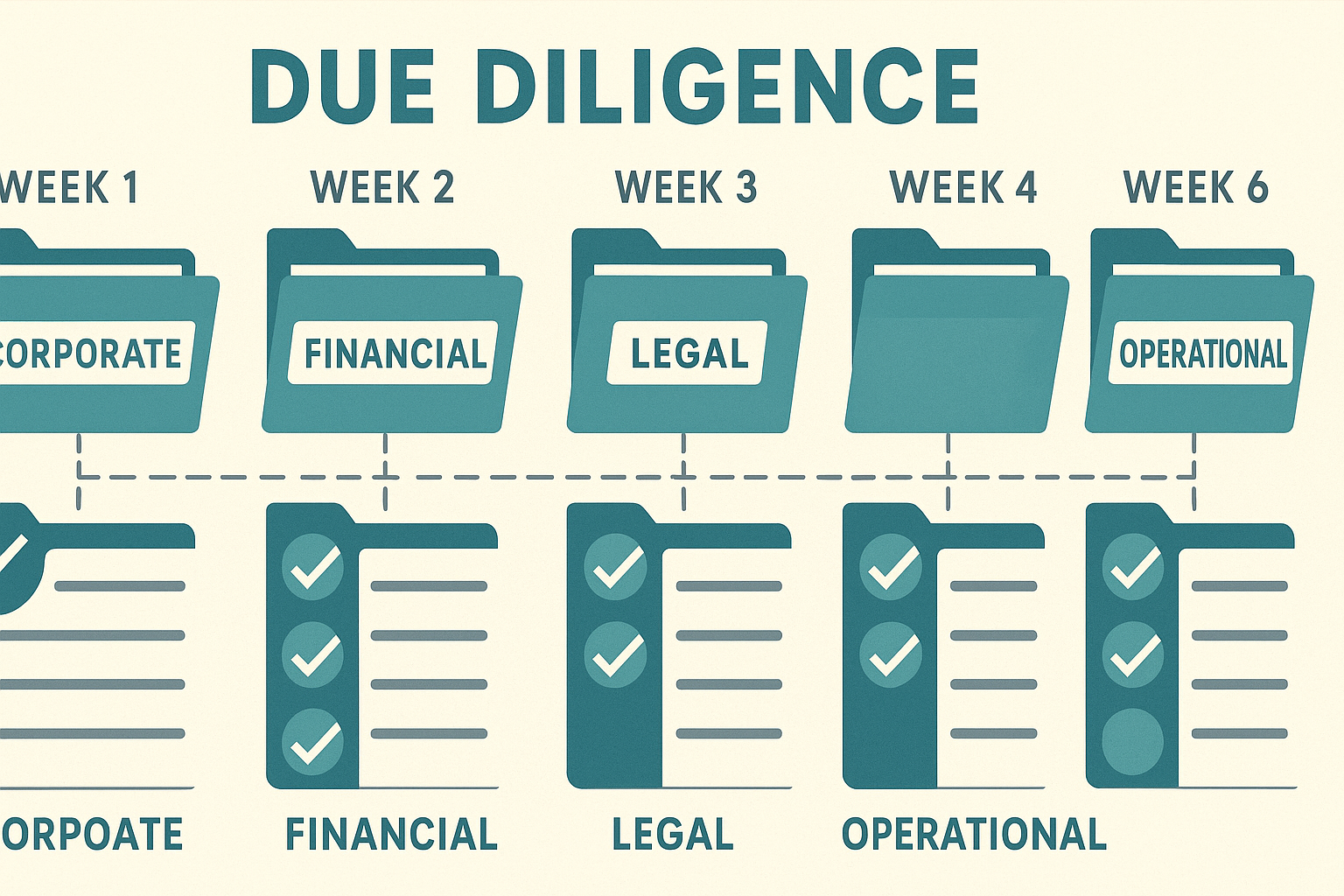
Due diligence is not a paperwork exercise. It is the moment when another party tests whether your numbers, contracts, and operational claims are real — and whether your team can respond under pressure without improvising.
This due diligence guide explains how diligence works across M&A, fundraising, and commercial partnerships. You’ll learn what buyers and investors typically request, how to organise and present documents, how to run Q&A efficiently, and how to avoid the most common diligence failures that create delays, price adjustments, or broken trust. If you are worried about being overwhelmed by requests or exposing sensitive information too broadly, this guide is designed to help you take control of the process.
What due diligence is really assessing
Diligence is a structured risk audit. Counterparties want evidence that (1) the business exists as described, (2) revenue and margins are defensible, and (3) known liabilities are manageable.
Security and data governance have also become standard diligence topics. The IBM Cost of a Data Breach Report 2025 puts the global average breach cost at $4.4M — which explains why buyers and investors increasingly ask about access controls, incident response, and privacy posture even in mid-market deals and growth-stage fundraising rounds.
Types of diligence to prepare for
A complete diligence preparation covers six workstreams:
- Financial diligence: quality of earnings, revenue recognition, working capital trends
- Legal diligence: corporate records, contracts, disputes, IP ownership
- Commercial diligence: customers, churn, pipeline, competitive positioning
- Operational diligence: processes, supply chain, key vendors, scalability
- Tax diligence: filings, exposures, transfer pricing where relevant
- Technology and security diligence: architecture, access management, controls, incident history
How to run due diligence with less chaos: 4 principles
1) Build a clear index and ownership map
Assign one internal owner per document category — finance, legal, HR, and product each need a named responsible person. That owner is accountable for completeness and for response speed when questions come in.
2) Stage sensitive disclosure by deal phase
Not every party needs everything at once. Stage access to reduce leakage risk and keep early conversations focused on decision-critical questions. Deeper commercial and security materials can follow once serious intent is confirmed.
3) Use a single Q&A channel
Email-based Q&A creates inconsistencies and loses context. Use a structured approach — ideally within a VDR’s Q&A module — or at minimum a tracked log with references to the specific documents that answer each question. Consistent answers build trust; inconsistent ones destroy it.
4) Maintain a live changelog
When you upload updated files — a revised forecast, a new customer contract, an amended policy — log the change explicitly. Reviewers need to understand what changed and why, without having to compare versions manually.
Due diligence document checklist (by category)
Use this as a starting framework and tailor it to your deal type and jurisdiction.
- Corporate: incorporation docs, cap table (including options, SAFEs, and convertibles), board approvals, subsidiary structure
- Financial: monthly statements, forecasts, debt schedules, revenue recognition policy, budget vs actuals
- Customers: top contracts, renewal terms, churn analysis, pricing policy
- Vendors: key supplier agreements, SLAs, material subcontractor relationships
- IP: founder and employee IP assignments, trademarks/patents, open-source usage policy
- People: employment agreement templates, incentive plans, key-person dependencies
- Risk: disputes, insurance policies, compliance posture, security overview and incident history
A diligence timeline that you can reuse
| Phase | Weeks | Key activities |
|---|---|---|
| Setup | 0–1 | Room creation, index build, initial document upload, staged permissions |
| Active review | 1–3 | Q&A responses, targeted uploads, management calls |
| Confirmatory | 3–6 | Deeper diligence, disclosure schedules, third-party confirmations |
| Closing | Final | Bring-down items, consents, board approvals, closing deliverables |
Choosing the right tooling for diligence
If you are sharing sensitive information with multiple external parties, a VDR typically reduces both risk and administrative burden through structured access control, audit logs, and managed Q&A. If you are still deciding, start with what is a virtual data room, then use Compare Providers to evaluate options against your deal type and timeline.
Common diligence mistakes — and the fixes
Mismatched KPI definitions: publish a one-page definitions sheet at the start of the process and reference it in Q&A. Inconsistent ARR, NRR, or CAC definitions are one of the fastest ways to undermine buyer confidence.
Missing IP assignments: collect contractor and founder IP assignments before diligence begins. This is a close-to-universal gap in early-stage technology businesses — and one that is much harder to fix under time pressure.
Untracked updates: replace files rather than adding new versions silently. Log every update in a changelog with the date and reason.
Overbroad access in early stages: stage disclosure and enforce least privilege. External parties should see only what they need for the current phase.
FAQ
The volume varies by industry, deal size, and buyer type, but most friction comes from poor organisation rather than the volume of requests itself. A well-prepared room with clear structure dramatically reduces the number of follow-up questions.
Often yes — at the early stages, summaries and redacted terms are appropriate. Disclose full terms when the counterparty has confirmed serious intent and is under a binding NDA.
Earlier than you think. A well-structured room reduces Q&A volume, signals operational maturity, and gives management more control over the pace of disclosure. Waiting until diligence is formally requested means scrambling under time pressure.
Take the next step: if you are preparing for a process, start with the due diligence checklist for startup fundraising or go straight to Compare Providers to choose your tooling.